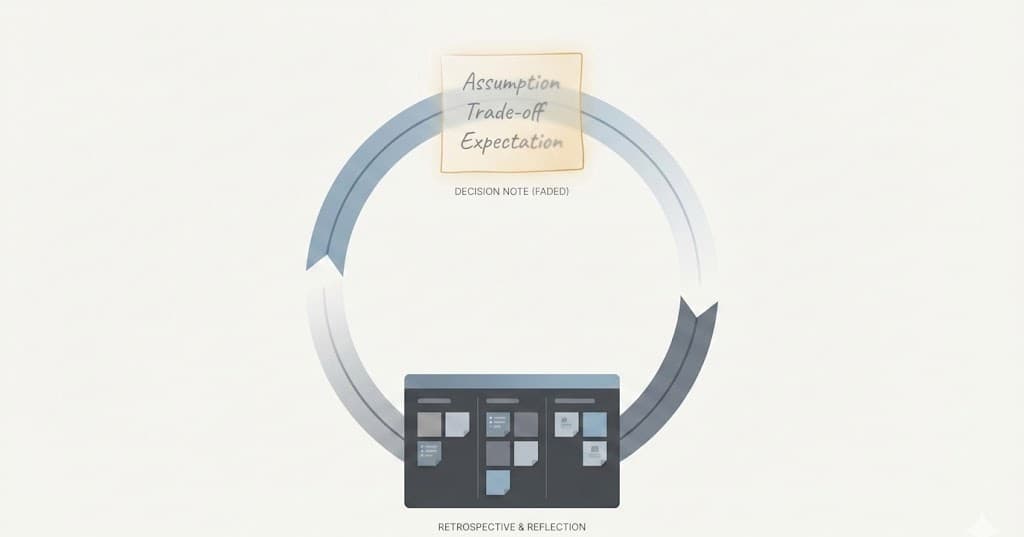
Why Retrospectives Struggle Without Decision Memory
Retrospectives are necessary. But without preserved decision context, teams are forced to reconstruct intent from outcomes.
Retrospectives exist for a reason.
They create space to reflect. They surface friction. They help teams realign.
Done well, they are one of the healthiest habits a team can have.
And still, many teams experience the same frustration:
They talk. They agree. They leave with action items.
Then, weeks later, the same discussions return.
Not because the team is careless.
Because something subtle is missing.
The Problem Isn’t Retrospectives
When retrospectives feel unproductive, the instinct is to fix the retro.
Better facilitation. Better prompts. More honesty. More structure.
Those improvements help.
But they do not address the core failure mode.
Retrospectives operate downstream of decisions.
By the time the retro begins, the most important context has often already decayed.
What Retrospectives See
Retrospectives can reliably see:
- what happened
- what hurt
- what surprised the team
- what outcomes emerged
They can also see symptoms:
- missed deadlines
- rising incident counts
- slower releases
- user complaints
What retrospectives struggle to see is the thing that produced those outcomes.
The decision.
Decisions Collapse Into Outcomes
Every meaningful change begins as a decision.
A trade-off was accepted. An assumption was made. A bet was placed.
Then the change ships.
At that moment, the decision collapses into:
- code
- configuration
- UI copy
- operational behavior
Weeks later, the team sees outcomes.
But the original intent is no longer present.
So the retro has to guess.
Outcome-First Conversations Create Fiction
When decision context is missing, teams reconstruct it.
They reverse-engineer why something was done.
They narrate the past from the present.
They fill gaps with plausible stories.
This is not incompetence.
It is the default human response to missing memory.
But it produces a specific failure:
The team debates interpretations instead of learning.
Two people remember different reasons.
A third person wasn’t there.
Someone says: “It made sense at the time.”
And the retro becomes a negotiation about what the decision must have been.
Why Action Items Don’t Stick
Many retrospective action items fail for the same reason.
They target symptoms.
Not decisions.
Without knowing:
- what trade-off was accepted
- what assumption was relied on
- what expectation was declared
the team cannot produce a correction that actually matches the cause.
So improvements drift.
And the same issues return.
The Missing Layer: Decision Memory
Retrospectives don’t need to be replaced.
They need support upstream.
Decision memory is that support.
A minimal decision trace captures:
- what was decided
- why it made sense at the time
- what was expected to change
Not as documentation.
As time-anchored intent.
When that intent is preserved, retrospectives become dramatically clearer.
Because outcomes finally have something to meet.
Retrospectives Work Better When They Don’t Have to Guess
With decision memory:
- the team can evaluate outcomes against expectations
- trade-offs can be revisited without blame
- assumptions can be tested instead of defended
The retro stops being a debate about the past.
It becomes a feedback loop.
Decision-Centric Development
Decision-Centric Development treats decisions as first-class artifacts.
It does not compete with retrospectives.
It strengthens them.
By making sure the most fragile part of learning survives:
what we believed when we chose to act.
Because retrospectives are necessary.
But without decision memory, they are forced to reconstruct intent from outcomes.
And reconstruction is not learning.
Afterchange Team
Helping teams track decisions and measure impact.