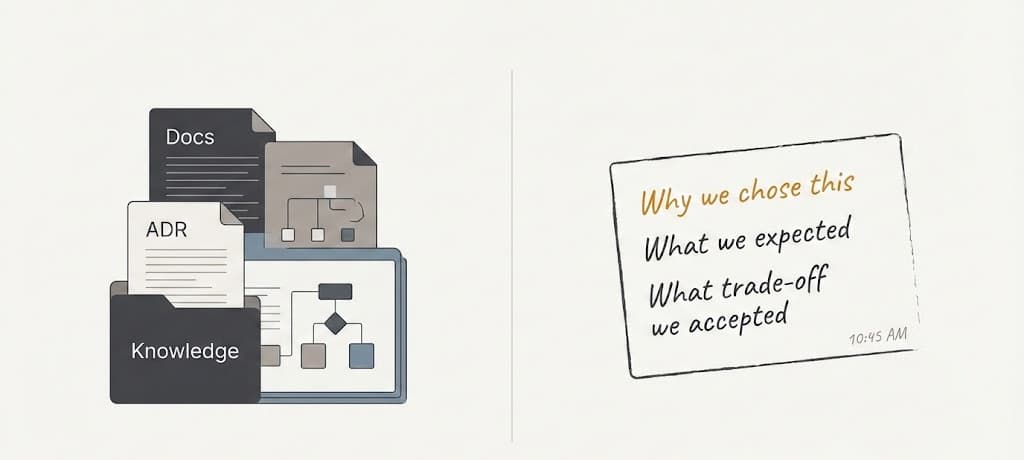
Decision-Centric Development Is Not Documentation
Documentation explains what we know. Decision-Centric Development preserves why we acted.
When teams hear Decision-Centric Development, they often map it to something familiar.
Documentation.
ADR files.
Confluence pages.
A place where decisions are written down.
That assumption is understandable.
And fundamentally wrong.
Documentation Explains Knowledge
Documentation exists to explain what is known.
How a system works. What a feature does. Which approach was chosen.
It is written after understanding stabilizes.
It is optimized for clarity.
It assumes the question is:
“How does this work?”
Documentation is valuable.
But it does not capture decisions.
Decisions Happen Before Knowledge
Decisions are made before certainty exists.
They are acts of judgment under incomplete information.
A decision answers a different question:
“Given what we know now, what should we do?”
At that moment:
- trade-offs are accepted
- assumptions are unresolved
- expectations are explicit but fragile
Once the outcome arrives, knowledge replaces judgment.
And the decision disappears.
Why Documentation Fails as Memory
When documentation is used as a proxy for decisions, teams lose critical context.
They remember what was built.
They forget:
- why this option was chosen
- which alternatives were rejected
- what outcome was expected
Later, when results are reviewed, teams reconstruct intent retroactively.
They explain past decisions using present knowledge.
This is not learning.
It is narrative repair.
Decision-Centric Development Starts Earlier
Decision-Centric Development does not document conclusions.
It records intent at the moment of commitment.
Not polished explanations.
Not justifications.
Not post-hoc reasoning.
Just:
- what was decided
- why it made sense at that time
- what change was expected to follow
This context exists only briefly.
If it is not captured, it is lost.
ADRs Are Close — But Still Different
Architectural Decision Records move in the right direction.
They acknowledge that decisions matter.
But they still behave like documentation:
- written after implementation
- optimized for completeness
- detached from real outcomes
Decision-Centric Development treats decisions as living references, not static records.
They remain connected to what actually happened.
Why This Distinction Matters
Without decision context:
- metrics lose meaning
- retrospectives become speculative
- teams repeat the same debates
With decision context:
- outcomes can be evaluated fairly
- failure becomes instructive
- success becomes explainable
Learning becomes durable.
Not Documentation. Memory.
Decision-Centric Development does not compete with documentation.
It complements it.
Documentation explains the system.
Decision-Centric Development explains the path that led there.
One preserves knowledge.
The other preserves judgment.
Both are necessary.
But they are not the same.
Afterchange Team
Helping teams track decisions and measure impact.