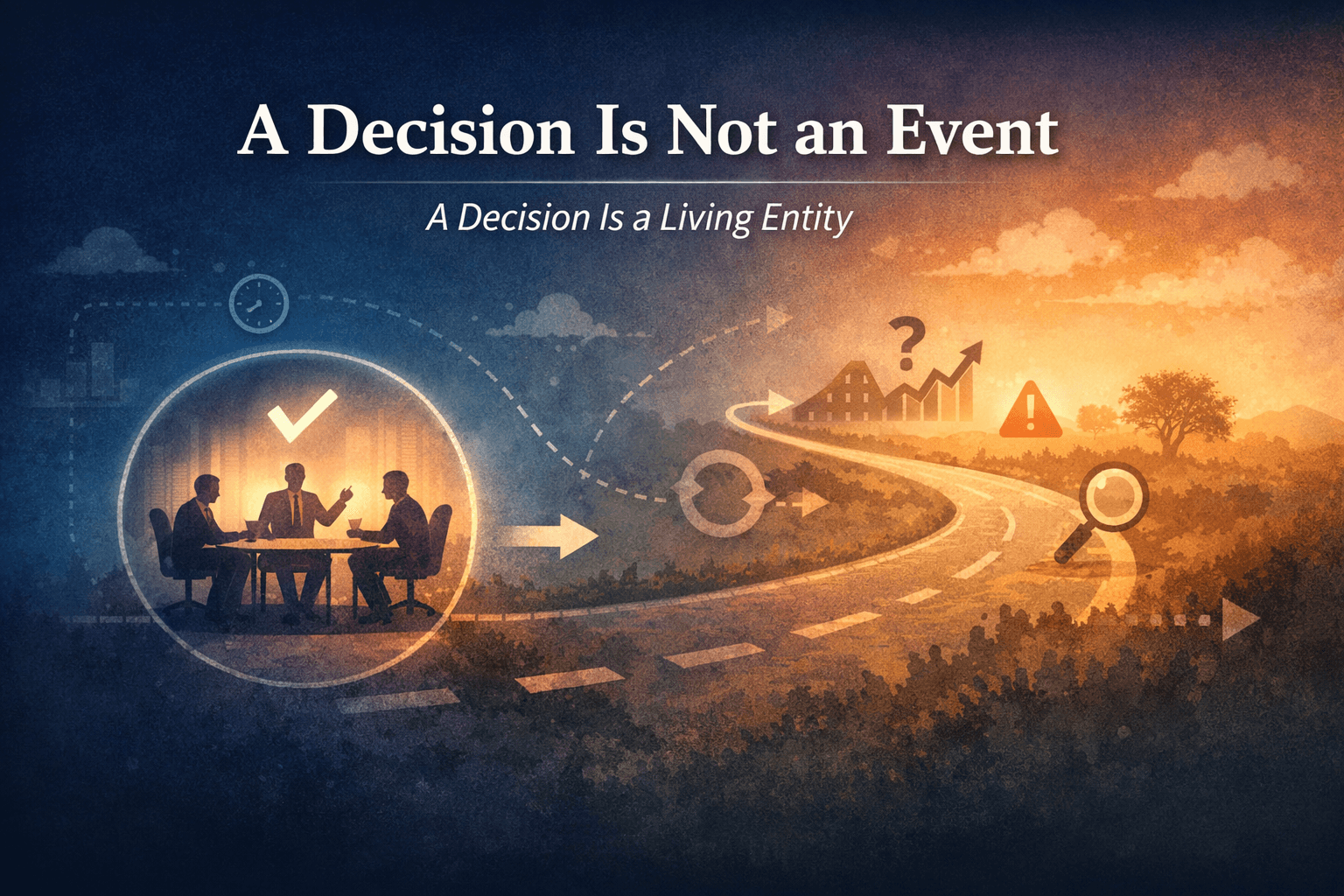
A Decision Is Not an Event
A decision is not a moment in time. It is a living entity whose correctness is tested over time.
Most product systems treat decisions as moments.
A meeting ends. A document is approved. A pull request is merged.
The decision is considered complete.
But this assumption quietly breaks learning.
Because a decision is not an event.
A decision is a living entity whose correctness is tested over time.
The Event Fallacy
Modern product tooling is built around events.
Deployments. Releases. Experiments. Metrics moving up or down.
Events are easy to capture. They happen at a point in time. They are observable.
Decisions are not.
A decision does not end when it is made.
Its real work begins after.
What Actually Happens to Decisions
Every meaningful product change starts with intent:
- a trade-off is accepted
- an assumption is made
- an expectation is formed
That intent becomes code.
Once deployed, the decision disappears into the system.
What remains visible is only the outcome.
Metrics move. Dashboards update.
The reasoning that led there is gone.
Why Outcomes Alone Cannot Teach
Teams often try to learn by looking only at results.
If numbers went up, the decision is assumed to be good. If numbers went down, it is assumed to be bad.
This is misleading.
Without knowing what was expected to change, outcomes lose meaning.
A decision can fail for the right reasons. A decision can succeed for the wrong ones.
Outcomes without expectations cannot teach.
Decisions as Living Entities
Treating decisions as entities changes the frame.
An entity:
- persists over time
- has context
- can be revisited
- can be evaluated against expectations
A decision, viewed this way, has a lifecycle:
- a problem is identified
- a decision is made
- a change is applied
- signals emerge
- reality confirms or diverges
- the decision is revisited
This loop is where learning actually happens.
The Memory Problem
Teams rarely struggle because they lack data.
They struggle because they lack memory.
Memory of:
- why a decision made sense at the time
- what alternative paths were rejected
- what signal was expected to move
Slack does not preserve this. Tickets do not preserve this. Dashboards do not preserve this.
They were never designed to.
Decision-Centric Development
Decision-Centric Development starts from a different premise.
That decisions themselves are first-class artifacts.
Not as documentation. Not as justification. Not as bureaucracy.
But as explicit, timestamped intent.
When this intent survives alongside outcomes, learning becomes possible.
Success can be examined without hindsight bias. Failure can be analyzed without blame.
Why This Category Did Not Exist
This approach did not emerge as a feature request.
It emerged from a recurring failure mode.
Teams could explain everything that happened.
They could no longer explain why they chose to make it happen.
The gap was not analytical.
It was conceptual.
Beyond Dashboards
Dashboards are necessary.
They show movement. They reveal patterns. They surface anomalies.
But they operate downstream of decisions.
Decision-Centric Development operates upstream.
Until decisions are treated as entities that persist through time, learning will remain fragile.
Because change without memory is just motion.
And motion, by itself, is not progress.
Afterchange Team
Helping teams track decisions and measure impact.